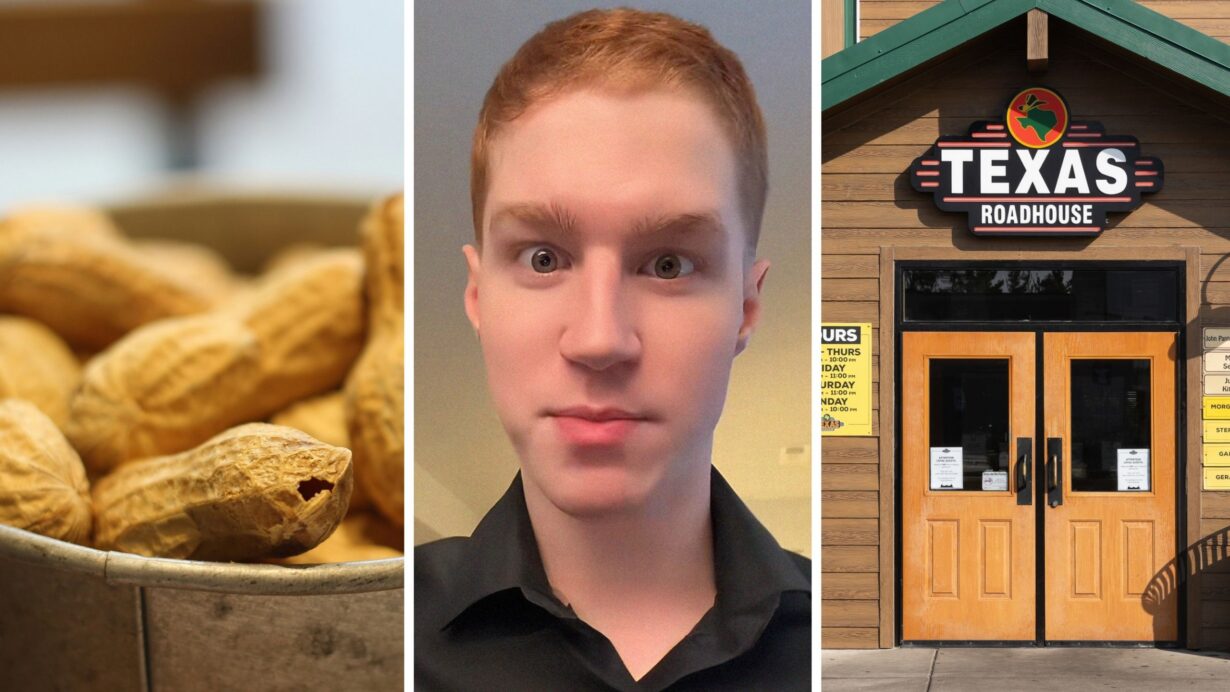

A Texas Roadhouse server posted a divisive opinion about peanut allergies and accommodations restaurants can reasonably make for customers.
What Did the Texas Roadhouse Server Say About Customers With Peanut Allergies?
In a video that received more than 248,000 views, a content creator named Jonny (@jonnyhuxe) discussed his experience serving at Texas Roadhouse and one request he thinks is unreasonable. The ask? Fully deep-cleaning the booths when a customer with a peanut allergy wants to dine in.
The content creator said that because of the amount of peanuts shelled at Texas Roadhouse, it would be difficult to serve a customer with a peanut allergy, making it not the best place for someone with a severe allergy to dine.
Jonny’s video led with a simple question that led to a divisive brawl in his comments section.
“If you’re allergic to peanuts, why are you going to a Texas Roadhouse?” he asked.
“The number of people that call and they’re like, ‘Hey, just so you know, my daughter is fatally allergic to peanuts. That being said, we’re coming to eat at your restaurant,’” he continued. “‘I’m coming to eat at a restaurant [where] the thing that your restaurant is famous for I am deathly allergic to.’ Where’s the reasoning behind that?”
‘All Our Texas Roadhouses Stopped Serving Peanuts Years Ago!’
A majority of Jonny’s viewers said that it’s reasonable not to serve a customer with a severe peanut allergy, especially if the restaurant cannot guarantee their safety during service.
One commenter, who described their own experience working in hospitality, said, “We are an Asian style restaurant; we have peanuts in dishes on our menu. We have people booking reservations online with extreme peanut allergies, then they’re annoyed when I call to tell them we cannot serve them.”
Another commenter, who said they work at an Italian restaurant, echoed a similar experience. “I …had a lady tell me, ‘I’m allergic to gluten, dairy, and tomatoes. What can I have?’ GET OUT!!” they said.
But other commenters said they didn’t want to be turned away because of an allergy.
“Well, I’m allergic to peanuts, not delicious hot bread and frozen margaritas,” a viewer said.
Can a Peanut Allergy Really Be Airborne?
The debate over diners with peanut allergies led to another question. Multiple commenters said that airborne peanut particles, contrary to popular belief, cannot cause anaphylaxis. But is that true?
The idea that peanut particles can cause severe allergic reactions is a common myth. As one study notes, there’s “no evidence to support airborne transmission of nut allergens as a likely phenomenon.” And while a person might have a slight airborne-induced reaction, especially when surrounded by deshelled peanuts, airborne anaphylaxis is a largely unsupported phenomenon.
In another study, 84 children with peanut allergies were placed in a room with a bowl of peanuts “for 30 min under controlled conditions.” Researchers also exposed children to airborne peanut proteins with “varying distances” and “varying times.” The exposure tested whether any children would experience severe reactions. None of the children did. Two, however, “had mild rhino-conjunctivitis which required no treatment.”
A restaurant full of deshelled peanuts, however, still poses a moderate to severe risk to someone with a peanut allergy. Peanut residue on tables, chairs, and booths can cause anaphylaxis. It’s also unclear if Texas Roadhouse has a specific policy for diners with peanut allergies.
The Gray Area With Allergies
In the culinary world, it can be difficult to guarantee that dishes are allergy-free. A restaurant that regularly deshells peanuts can’t make many promises, although it can warn customers and promise to clean booths. But in what situations could a restaurant actually be liable for exposing a customer to an allergy?
If a restaurant doesn’t warn someone about a potential allergy risk after the customer tells the restaurant about it, the business may be liable.
Servers don’t have to spell out the ingredients list for customers if they haven’t already discussed an allergy. Customers usually have to provide allergy information first.
Additionally, some chains and businesses offer customers blanket allergen statements rather than over-promising on food. If a customer says they have an allergy, a server might tell them there’s no guarantee any of the dishes coming out of the kitchen will be safe. That makes restaurant menus incredibly limiting for individuals who do have allergies. But it does protect the restaurant from future legal dilemmas.
Subplot News reached out to Jonny and Texas Roadhouse via email. We will update this story if they respond.
@jonnyhuxe I’m tired of pretending peanut allergy girls are normal #peanutallergy #restaurant #texasroadhouse #server #fyp ♬ original sound – jonnyhuxe