
Regardless of any economic uncertainty, Americans still love dining out.
As an example, according to data from the OpenTable 2026 dining report, dining out has increased 8% year over year in 2025. The report also predicts that Americans will dine 10 times per month in 2026.
To satisfy this demand, over 2.27 million people were employed as waiters or waitresses in 2025.
Yet, a growing number of people online seem to reject tipping servers and are growing resentful toward servers.
That’s despite the fact that federal law recognizes “tipped employees.” This allows employers to pay as little as $2.13 per hour in direct wages as long as tips bring the worker’s total pay to at least the federal minimum wage of $7.25 per hour. If tips don’t make up the difference, the employer has to.
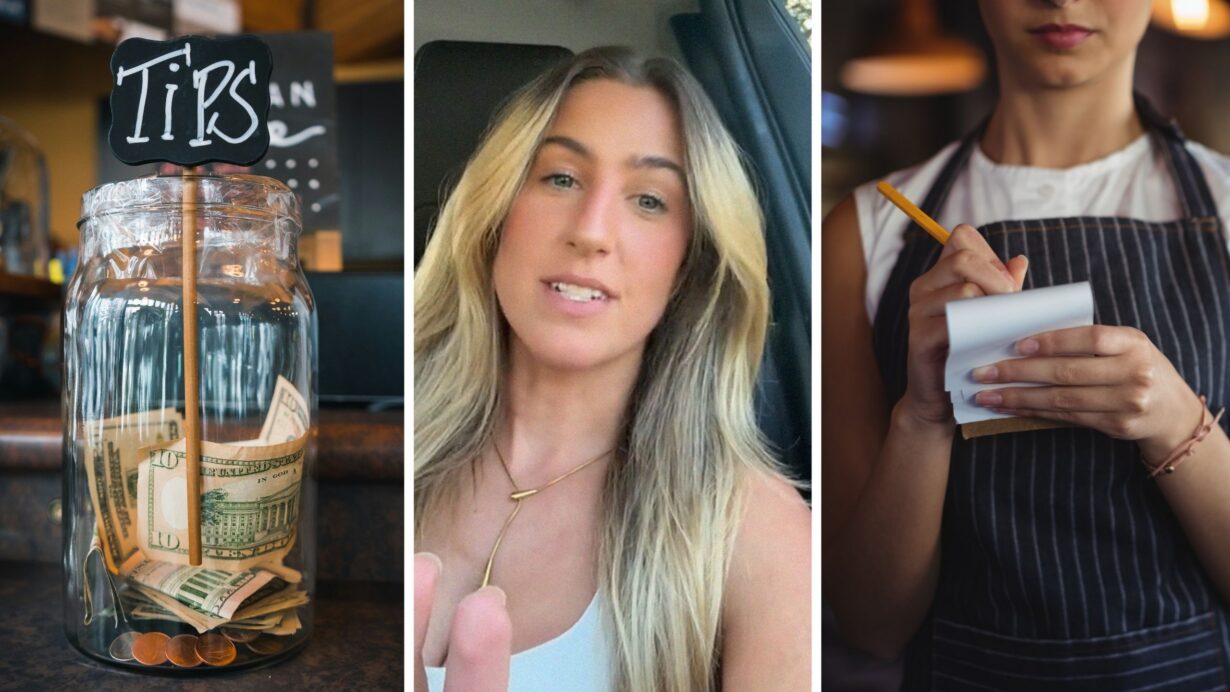
One server on TikTok, Lexi Natowarski (@lexinowotarski), says she has already noticed lower tips. In her video, she explains how this affects workers like her, and some fact customers should keep in mind.
Server explains why tips matter more than customers think
Natowarski says she has served in both Pennsylvania and Tennessee. There, she says she made around $2.13 to $2.15 per hour before tips.
“So right off the bat, that shows you that we are getting underpaid, so we rely on tips to push us over that amount,” she says.
She knows one common response is that restaurants should simply pay their workers more. However, she believes customers who refuse to tip are taking that frustration out on the wrong party.
“If your argument is going to be that the restaurant needs to pay us more, I think you need to take that up with the restaurant,” she says.
She also acknowledges that not every server deserves a great tip.
“I do understand that a tip should be based off of service,” Natowarski says. “So it is OK if you tip lower on some occasions than others.”
However, she asks customers to consider what else may be happening inside the restaurant before blaming their server. The restaurant may be busy, the server may have several tables at once, or someone else may have made a mistake with the food.
She brings up another common response: “That’s your job.”
“We are working a job that we expect to be paid,” she says.
She says she personally expects at least an 18% tip when she provides great service.
“I’m not working this job to make bare minimum,” Natowarski says. “I’m working my [expletive] off and trying to connect with my tables to make the most I can.”
She also explains that serving is her second job alongside a corporate position.
“I choose to be a server because I need a second job, and it can be well paying if you put in the work and have great tables,” she says.
Tip-outs are another factor people don’t know about
Natowarski also addresses customers who question why they should tip a percentage of the bill rather than a set amount.
She uses the example of someone ordering an appetizer versus a more expensive steak dinner.
According to Natowarski, one reason is that servers often have to share a portion of their sales with other workers. This is indeed a common practice in the restaurant industry.
“I have a back server, I have a bar, I have food runners that I tip out,” she says.
She explains that those tip-outs are based on total food or drink sales. This means a server owes more money to staff when a customer orders a more expensive meal.
“So just because you picked a steak instead of an appetizer, I have to pay more for you getting that steak than I did for you getting that appetizer,” she says. “So that’s why you need to tip based off of the amount you spend.”
She says the same can apply to drinks ordered from the bar.
“If you don’t tip us over 10% for the drink you ordered, we made nothing off you,” she claims.
Natowarski says serving can sometimes pay very well, but that doesn’t happen every shift.
“I’ve had tables that have left me big tips and I’ve walked out with over $1,000 in an eight hour shift,” she says.
She says she has also had weeks where her tips were low enough that the restaurant had to make up the difference for her to reach minimum wage.
She disagrees with people who say servers make too much money from tips.
“Most servers don’t make a boatload of money like some of the videos you see online,” she says.
She thinks dining out means accepting that tipping is part of the experience.
“Eating out is a luxury and you have to factor in that tipping is part of the process,” she says. “If you don’t wanna tip there are other options for you.”
For those who plan to tip very little regardless of the service, Natowarski has a suggestion.
“How about you be honest the next time you go out and eat,” she says. “And right when the server gets you, let them know that you will only be tipping a certain amount no matter what you get and see how you get waited on.”
Natowarski ends the video by saying that serving may only be her second job. But for many others, it is the main way they make their money.
“If everyone had the mindset like you where tipping culture’s out of hand and you’re gonna always tip below 10%, they will not make ends meet,” she says.
@lexinowotarski
Viewers Were Split
In the comments, some zero-tip believers chimed in, while others said they still tip traditional servers.
“You forgot to mention by federal law if you’re hourly wage and tips don’t equal minimum wage you’re employer must make up the difference,” one commenter wrote. “I never tip the servers aren’t my employees and I don’t give my money away. #notip2026”
Natowarski responded with a clarification.
“GIRL. like I said in my video… the restaurant will make up the difference for me to hit $7.25/hour (NOT A LIVABLE WAGE BTW),” she wrote. “You don’t have to go out to eat, you can take to-go and don’t need to tip on that. If you tip me nothing on your bill, I pay for YOU to eat out so that completely contradicts what you just [expletive] said.”
Another commenter said traditional tipping isn’t the issue.
“Most people know to tip traditional servers as usual,” they wrote. “It’s the tipping exhaustion from a place where you order from a counter, make your own drink, then pick up your own food, clean your trash and put away everything AND then ask for a tip.”
Others thought tipping habits are a good character indicator.
“You can tell a lot about a person by how they tip,” another wrote. “For example if someone orders DoorDash and allows someone to bring them their food and is ok with the driver making no money, then in general they probably won’t be a great person.”
Subplot News has reached out to Nowotarski via TikTok messages.