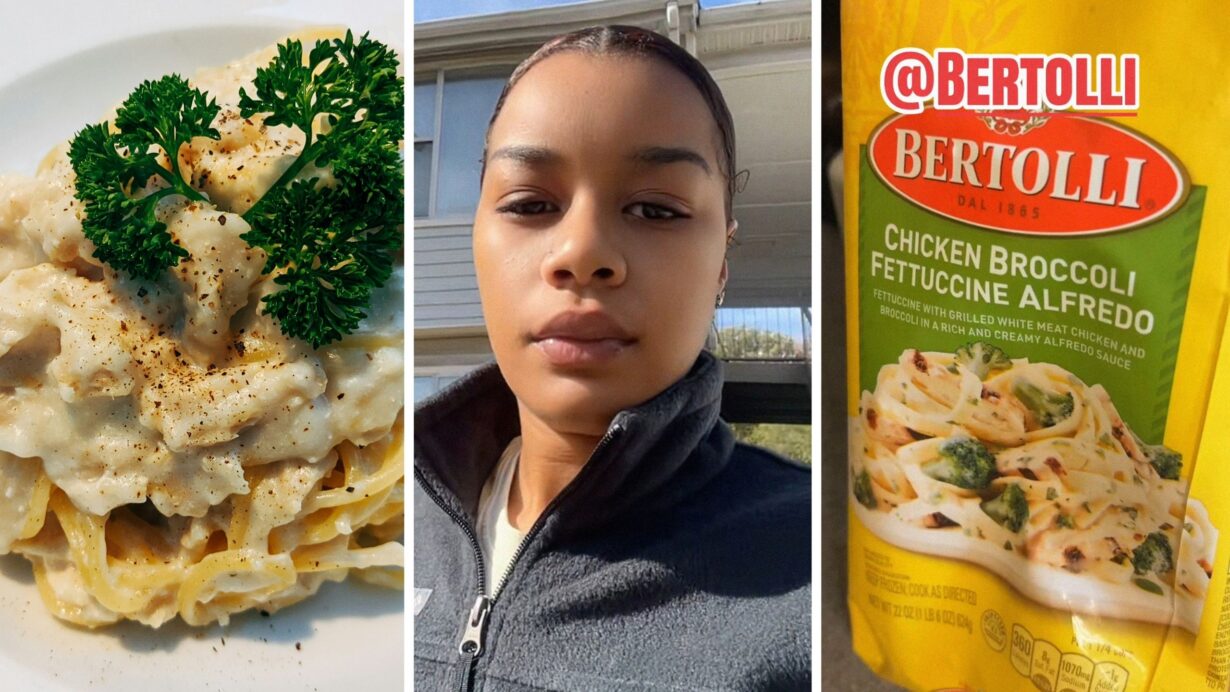

A woman is shocked when she realizes her frozen Bertolli Chicken Broccoli Fettuccine Alfredo has almost no noodles. Viewers question how reliable frozen meals really are.
On July 7, a woman (@alexus.ssssss) shared her discovery in a video that has amassed 29,300 views as of Friday. “Why the actual f— do I got one little roll of noodles?” she asks.
What Happened To The Woman’s Bertolli Frozen Meal?
The woman shows viewers that when she opened her package, the meal contained all the ingredients except for the noodles, with the exception of one small bundle. “All the rest of this s— is the sauce, the broccoli, and chicken,” she says.
“Where the f— are my noodles?” she asks. “This s— cost too much.”
Why Might The Bertolli Frozen Meal Have Had No Noodles?
The missing noodles could come from a manufacturing or portioning error. This was likely a mistake, as Bertolli lists cooked pasta as one of the main ingredients in the meal. However, the company does not publish an exact pasta-to-sauce ratio for the product.
Frozen meals typically go through highly controlled production processes. Workers and machines combine ingredients according to a set formula. The meals then get packaged, frozen, and distributed. That process can still produce occasional mistakes. In this case, the noodles may have failed to enter the package in the expected amount. A portioning problem could explain why the woman found one small bundle instead of a normal serving.
That does not mean customers should expect to find missing ingredients regularly. There is no reliable public statistic showing how often frozen meals leave the factory with dramatically incorrect ingredient proportions. Manufacturers generally treat those incidents as quality-control issues rather than normal variation.
Why Are Frozen Meals Becoming More Popular?
The frozen-food aisle has also become a major part of how Americans plan meals. In 2026, 40% of shoppers said they eat frozen foods every few days or daily. That figure increased from 35% in 2019. Nearly one-third of shoppers also said they planned to buy more frozen food.
Frozen food sales reached $74.2 billion in the year covered by a 2023 industry report. Consumers cited convenience, preparation time and value as major reasons for buying frozen foods.
More recent research shows that nearly every U.S. household purchased frozen food at least once during the previous year. Frozen foods have increasingly shifted from emergency backup meals to regular parts of weekly meal planning. That popularity likely makes quality-control complaints especially noticeable online.
Subplot requested a comment from @alexus.ssssss via TikTok direct message and the TikTok comment section, and from Bertolli via email.