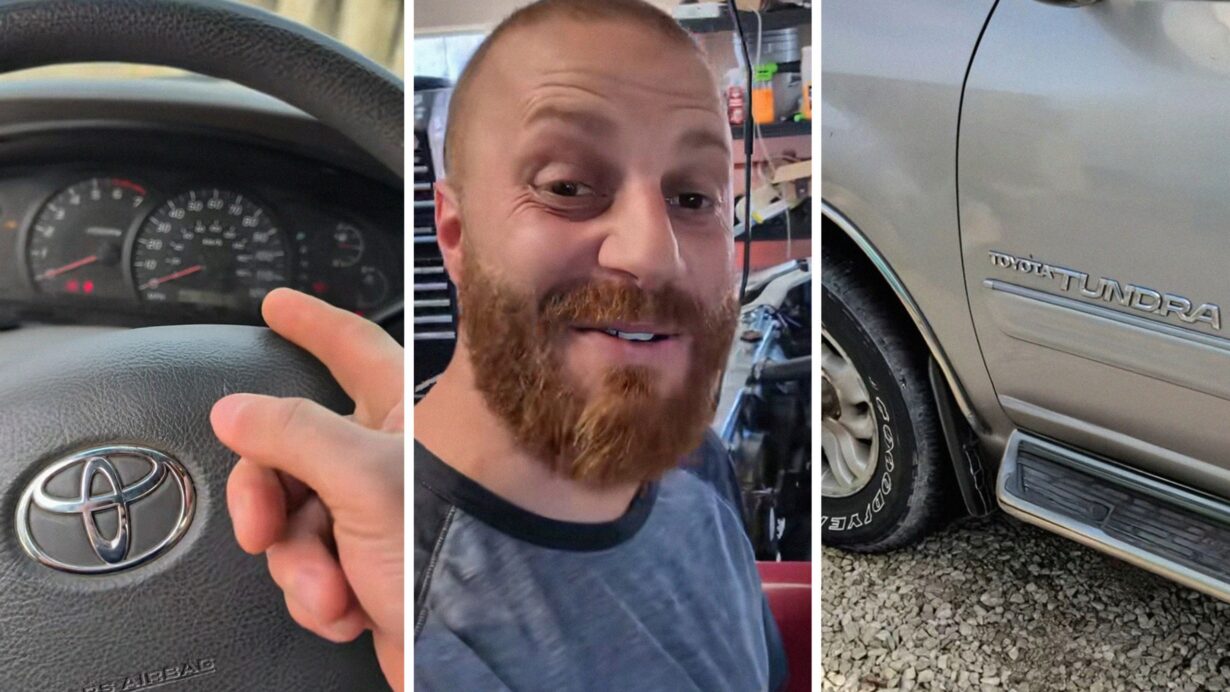

A Toyota Tundra owner had some questions about his car’s RPM meter gauge. In his mind it doesn’t make logical sense.
Luke Elias (@lifted_wrangler) is a gear head who routinely publishes videos on his work with cars.
He recently shared a thought about his Tundra’s tachometer. It left some folks worried and others wondering if he was joking.
“Someone please try and explain this,” he says. “So this truck is an original United States truck. But I live in Canada, so someone clearly imported it.”
He points at the speedometer.
“As you can see on the outside you have miles per hour, American units. And then on the inside you have kilometers, what the rest of the world uses. So that’s all fine and dandy,” he says.
The RPM gauge is a whole other story. “But how come they never did anything on the RPM side?” he asks.
Does RPM differ in other countries?
RPM stands for rotations per minute. In an engine, this refers to how fast the crankshaft rotates. There is no separate unit of measure for RPM per country like there is for many other units, such as speed, volume, and distance.
Speedometers measure distance. Tachometers (or RPM meters) measure rotational frequency.
So, if you drive at the same velocity in the same gear, then a car’s RPM will remain at the same level. Whether or not the speedometer is indicating the travel speed in miles or kilometers is irrelevant.
Why is this piece of equipment important? That’s because they let the driver know whether an actuator is working within a safe rotational range.
If the crankshaft or other rotational component is over-revving for too long, it can break. As RS-Online says, “This informs the driver when to shift gears taking the rotational speed of the shaft into account.”
Why RPMs matter for transmissions
When a gear shift occurs to late or is skipped/missed, push rods can be bent, connecting rods can be thrown out of whack, and other engine and/or gearbox damage can occur.
On the other hand, engaging a vehicle at consistently low RPMs under a high load can put too much stress on a transmission torque converter. Knocking can then occur inside of cylinders, which can ruin head gaskets and crack piston ring lands.
Additionally, connecting rods and crankshaft bearings can also fail under these loads. Not monitoring RPMs and shifting appropriately can also burn-out clutches prematurely. Bad shifts will culminate in friction mismatches between clutch discs and engine flywheels.
This is why drivers with manual transmissions often rely on tachometers to determine when they need to shift.
In automatic vehicles, both the transmission and tachometer communicate with the car’s PCM/ECU. Which means that the RPM meter is simply displaying the data that the car’s sensors are already logging.
The Transmission Control Unit (TCU) determines when down or up shifts are necessary. Vehicle speed sensors, throttle position sensors, crankshaft position sensors, and output shaft speed sensors also work in tandem to determine when automatic transmission shifts occur.
It’s important to note that tachometers are primarily used as visual indicators for RPM readings. So modern cars with manual transmissions still have the aforementioned sensors.
They are also often equipped with clutch pedal position (CPP) switches. Electronic auto-rev matching and hill-start assistance are also covered under this component as well. The tachometers are displaying data that’s already been processed by these sensitive sensors to ensure optimal vehicle performance.
Is he serious?
Several folks were left scratching their heads over Elias’ post about RPMs.
One pointed out that there doesn’t need to be a separate indicator for RPMs for miles vs kilometers. “I could be at 3,000 rpm going 65mph for 10mph depending on what gear I’m in,” he wrote.
Someone else wondered, “Is there a metric equivalent to revolutions per minute?”
One surmised he was kidding, writing, “Is this a joke? You can’t be for real, right?”
Another person decided Elias’ video is just a gag. “10/10 ragebait almost had me,” they wrote.
Subplot News has reached out to Elias via TikTok direct message for further comment.