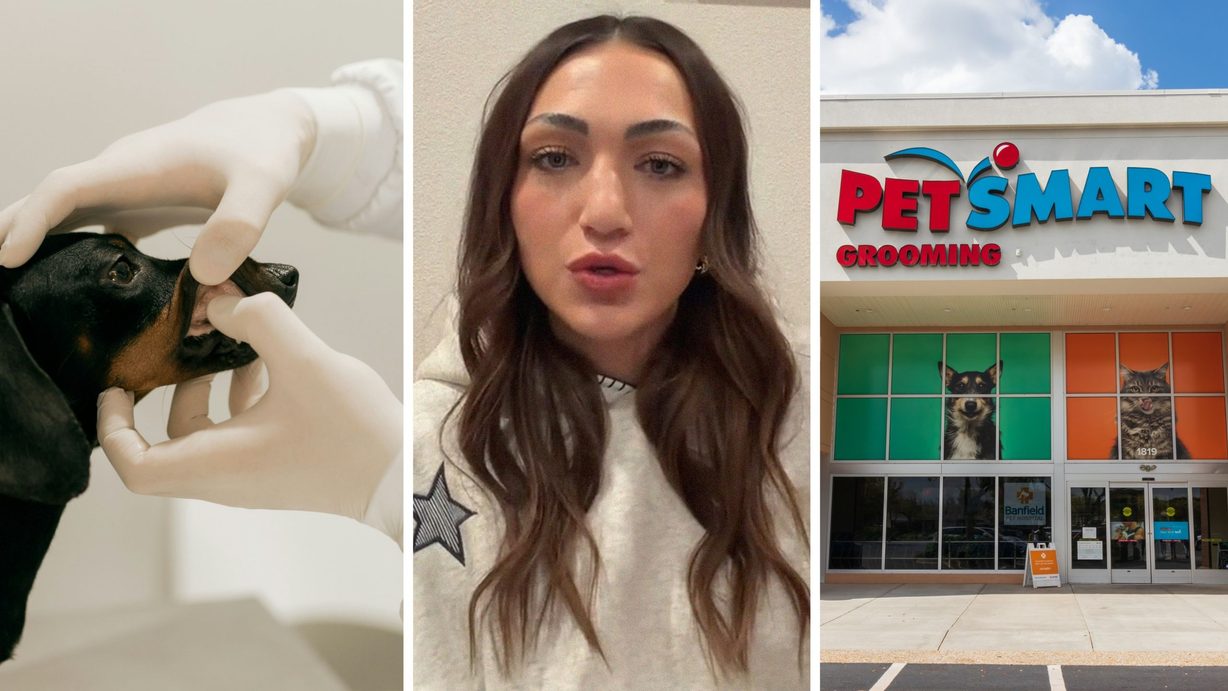

A Denver woman is warning other small dog owners to ask one specific question before their pet’s next dental cleaning.
The PSA comes after Steph (@littlelouiebigworld) took her 5-year-old miniature dachshund Louie to a new veterinarian. The veterinarian discovered something that hadn’t come up during years of annual appointments at Banfield Pet Hospital.
In a TikTok, Steph explains what happened after she decided to switch veterinary providers. Her video has more than 300,000 views.
“Quick PSA to any small dog owners, and specifically dachshund owners,” she says. “We took our dog in for his annual dental cleaning last week … We had kind of a traumatic experience … I wish I knew some of the things I know now.”
‘I’ve gotten a dental cleaning for him every single year’
Before bringing Louie home, Steph says she did “so much research” on miniature dachshunds. She says she “made sure to get him a dental cleaning every single year.”
“Dental cleanings can be super, super expensive,” Steph says. She eventually settled on Banfield Pet Hospital, the veterinary chain with locations inside PetSmart stores.
She says she paid about $60 a month that included an annual dental cleaning under anesthesia. According to Steph, Banfield would tell her “his teeth looked great,” aside from a little gingivitis.
“The thing I liked about Banfield is it was so convenient. It was also fairly affordable. I could go to any location. I could see any vet,” Steph says.
But after his most recent cleaning, Louie had a bad reaction to anesthesia and Steph “just didn’t like the way that Banfield handled it,” leading her to look for a new vet.
She ultimately found a veterinary dental clinic that came highly recommended by other dachshund owners. The initial estimate was anywhere from $500 to $1,500, depending on whether Louie would need extractions.
“I wasn’t anticipating him needing any extractions, because, again, I’ve gotten a dental cleaning for him every single year, and they’ve always said his teeth are perfect,” Steph says.
But two hours into his procedure, the clinic called with unexpected news. “We did the X-rays, and he does need six teeth extracted,” she recalls the vet saying. “I was so shocked,” says Steph. “I was so not expecting that.”;
‘Nobody ever told me how important they were’
Steph says the vet told her he’d worked for the chain himself. She adds that one of the reasons he left that job was “because they never do X-rays.”
He explained that dental X-rays are “absolutely a gold standard” in veterinary dentistry. According to him, they “need to be completed with every single dental cleaning.” They can unearth issues that aren’t visible during a regular exam.
Steph says she realized she may have never gotten Louie a dental X-ray.
She admits: “I feel like I kind of remember Banfield sometimes offering an X-ray, but it was always extra, and nobody ever told me how important they were, so I just never did them.”
According to the new vet, the X-rays revealed “some [abscessed] teeth and some crowding, which is very common in small dogs, specifically dachshunds.” What he actually found during the extractions was even more upsetting.
“They were green, super infected, pus-filled,” Steph recalls.
Steph says she began “spiraling” over the fact that “happy, energy-filled” Louie might have been in pain without her realizing it, adding that the vet told her “dogs can hide dental pain really, really well.”
She ends her video by advising small dog owners to “make sure that they’re getting their dental cleanings…and doing X-rays.”
“I know it’s an extra cost, but you could genuinely have no idea how much pain your dog is in until you do that X-ray and see how healthy their teeth actually are,” Steph concludes.
Are dental X-rays really necessary for dogs?
Veterinary dentists would agree with Steph’s X-ray warning. According to VCA Animal Hospitals, “dogs need to have their mouths X-rayed at least once every year,” even if their teeth, gums, and breath appear totally fine. This is largely because dogs can’t tell us when their teeth hurt.
“Remember, one human year is the same as 5-7 dog years, and people routinely have dental X-rays at least every other year,” the network of hospitals notes, adding that a dental cleaning without an X-ray “often results in missed opportunities to improve the quality of life and health of your dog.”
The American Animal Hospital Association (AAHA) cites research that found that 25% of visually normal teeth in dogs “had clinically important findings” when examined via X-ray.
And it’s true that small dogs need more dental care; a study from The Veterinary Journal even found that extra-small dogs (under 14.3 lbs) “were up to five times more likely to be diagnosed with periodontal disease than giant breeds.”
This is because smaller dogs have smaller jaws and thus less room for all of their 42 teeth. This problem worsens because smaller dogs “have a higher tooth-to-jaw-bone ratio,” meaning there’s less bone support for each tooth, which in turn means bone loss can happen much more quickly than in their larger-breed counterparts.
What about Banfield?
As for Banfield, the company’s website confirms that it offers dental radiographs as the third step in its professional dental cleaning process.
X-rays, however, are not listed as part of the “What happens during a professional veterinary dental cleaning?” FAQ on this same page alongside “scaling, polishing, and a full oral exam.”
@littlelouiebigworld
Subplot News reached out to Banfield Pet Hospital via its media hotline submission page and to Steph via email.