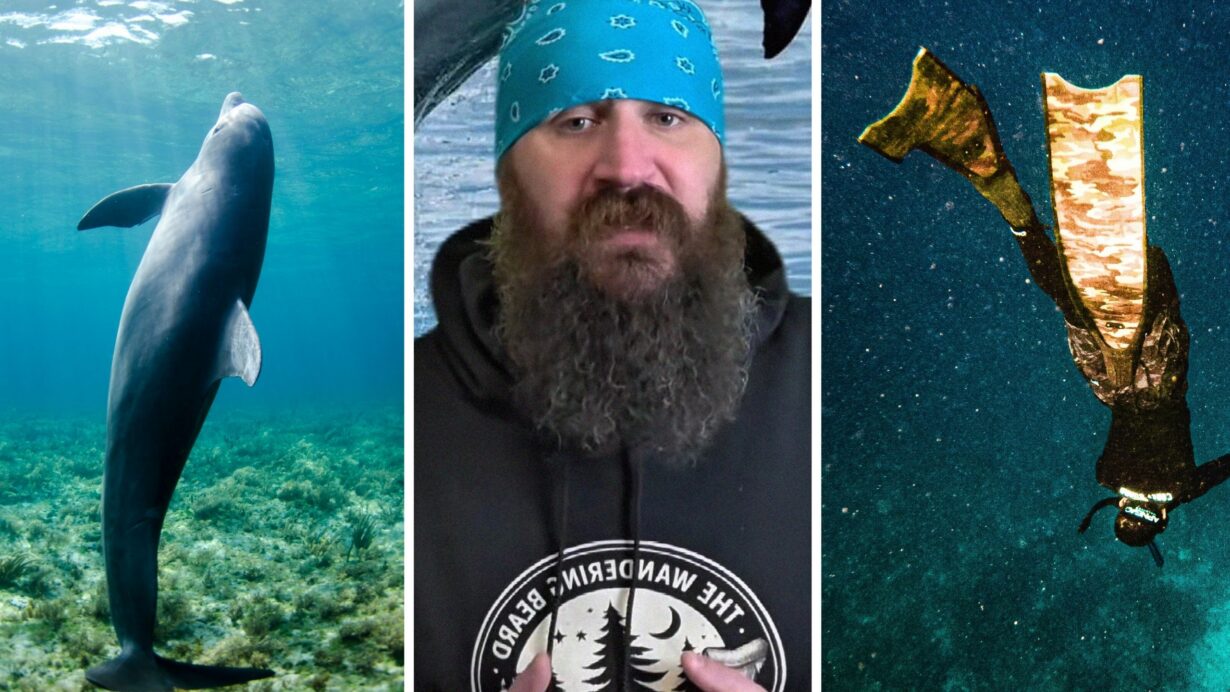

You’ve heard, presumably, of Navy SEALs. But have you considered Navy dolphins?
If you haven’t heard of anything like that, you’re in good company. One viral TikTok about Navy dolphins is currently going viral. Mostly, because people just can’t believe such a whimsical concept might actually be real.
What Attacked This Man Underwater?
Andrew Hooper (@thewanderingbeard2.0), a professional storyteller who specializes in telling true “scary” stories online, posted a video on Apr. 4. It has since accumulated over 1.7 million views. In it, he shares a curious marine encounter he allegedly experienced when diving in the Pacific Northwest in the middle of the night.
Hooper says he was “swimming along” in the pitch dark. He was trying to keep his bearings amidst jellyfish attempting to sting him in the face when an underwater behemoth suddenly confronted him.
“Out of nowhere, something huge, I mean something massive, comes out of the darkness and it slams me directly in the face, hard,” Hooper says. “And it knocks my regulator, my breathing apparatus out of my mouth. So now I’m 60 feet underwater in the pitch black and I can’t breathe.”
While this predicament might have stymied most people, Hooper says he’s a trained diver. As such, he was able to get his breathing device back on and head up to the surface. He told his team on his dive boat that he’d been attacked. He knew exactly what had come for him.
The Alleged Culprit: A Dolphin
“The thing that attacked me, the thing that slammed me in the face, was a 600-pound bottlenose dolphin,” Hooper says. “Now, again, that probably doesn’t sound normal to you, but the reason it was normal to me is because I worked at the time for the Navy Marine Mammal Program.”
He continued that he worked as a “defense contractor for the Department of the Navy as a dolphin and sea lion trainer/diver.” He said his job on this night “was to be an opposing force diver.”
Hooper explains that the Navy’s nuclear submarine bases are “protected in part, at all times, by at least one Navy dolphin and two Navy sea lions.”
“Their job is [to] detect enemy divers … and to stop them before any enemy diver could ever like place a limpet mine on one of our ships,” Hooper says. “So that’s what they do. And as an animal trainer … I would [occasionally] have to play the target, play as if I was an enemy diver trying to place a mine on one of these ships.”
He alleged that if [he] reaches the submarine, “then the animal has failed its job.”
“And the training team that’s working that animal at the time has failed its job,” he says. “But on this occasion, they did not fail. They found me.”
Commenters Are Skeptical
If Hooper’s half a million followers and hefty view counts are any indication, people are enthralled by his tall tales and storytelling skills. However, judging by the comments section of his dolphin video, some of this engagement comes from people’s abject disbelief that he could be telling the truth about militant marine mammals.
“I’m too gullible for this,” one viewer commented, clearly not buying it.
“I can’t tell if this is real or my gummy kicked in,” another wrote.
“IS THIS REAL OR SATIRE I CANT TELL?” a third pleaded.
Other viewers were simply delighted to have such a delightful nugget of information tucked away after having watched Hooper’s video.
“This wasn’t an option at the high school career fair and I’m pretty upset about it,” one viewer joked in the comments.
“This is such a fun fact to know, having animals working with the navy,” another marveled.
Viewers Are Entertained All The Same
Ultimately, people were just flabbergasted to know this is actually real life.
“The concept of dolphins that work for the United States is actually so insane,” a viewer commented.
“Have the dolphins ever protested their rights to form a union?” another joked.
“This is the equivalent of a dolphin choosing to work for corporate lol,” another wrote.
In an email to SubPlot News, Hooper confirmed that the tale was indeed true. He said it had happened during his tenure as “an animal handler/trainer/diver for the Marine Mammal Program.”
Does The Navy Actually Train Dolphins And Sea Lions?
Hooper’s account of trained sea critters fighting on the front lines for America might seem like a “Narnia“-esque fantastical notion. But if you were worried about Hooper’s story seeming too cool to be true, fret not.
The Navy does, in fact, train both dolphins and sea lions for military uses. There’s actually a word for these kinds of animals in general: military marine mammals.
Military marine mammals, which can also include seals and beluga whales, are exactly what they sound like. They’re aquatic animals trained by governmental programs “for detection, retrieval, and harbor defense.” Both the U.S. and the Soviet Union employed these programs during the Cold War.
In terms of modern-day America, the Naval Information Warfare Center (NIWC) Pacific’s Reconnaissance and Interdiction Division is in charge of the Navy’s Marine Mammal Program. It “trains bottlenose dolphins and California sea lions to detect, locate, mark and recover objects in harbors, coastal areas, and at depth in the open sea.”
What Does The Program Entail?
NIWC Pacific explains the program as being akin to service dog programs.
“Everyone is familiar with security patrol dogs, and how some service dogs use their keen sense of smell to detect explosives on land,” NIWC Pacific writes. “Since 1959, the U.S. Navy has trained dolphins and sea lions as teammates for our Sailors and Marines to help guard against similar threats underwater… Today, the Navy relies on [bottlenose dolphins and California sea lions]. Both are known for their trainability and adaptability to a wide range of marine environments.”
NIWC explains both species have “excellent low light vision and underwater directional hearing,” can dive hundreds of feet into the water without risk (unlike humans), and of course—in the case of dolphins—have “the most sophisticated sonar known to science.”
Lastly, regarding the ethics of the Marine Mammal Program, Hooper assures his viewers—along with SubPlot News via email—that “the animals are free to run/leave if they ever want to and they have top tier care.”
The Navy fits them with harnesses made of saltwater-soluble zinc, which allows them to disappear into open water if desired. But Hooper says that doesn’t happen very often because “they’re treated very well.”
“We have an amazing team of doctors and veterinarians, trainers, assistant trainers, all for the animals,” Hooper says in his video. “They get fed human-grade food, like food that’s fit for consumption for people. They have the best treatment in the entire world. Again, I know it’s controversial. I know these animals are so smart. A lot of us don’t want to keep them in captivity. But again, they do provide a very, very, very, very valuable service to the United States.”
We also reached out to the Navy via email.